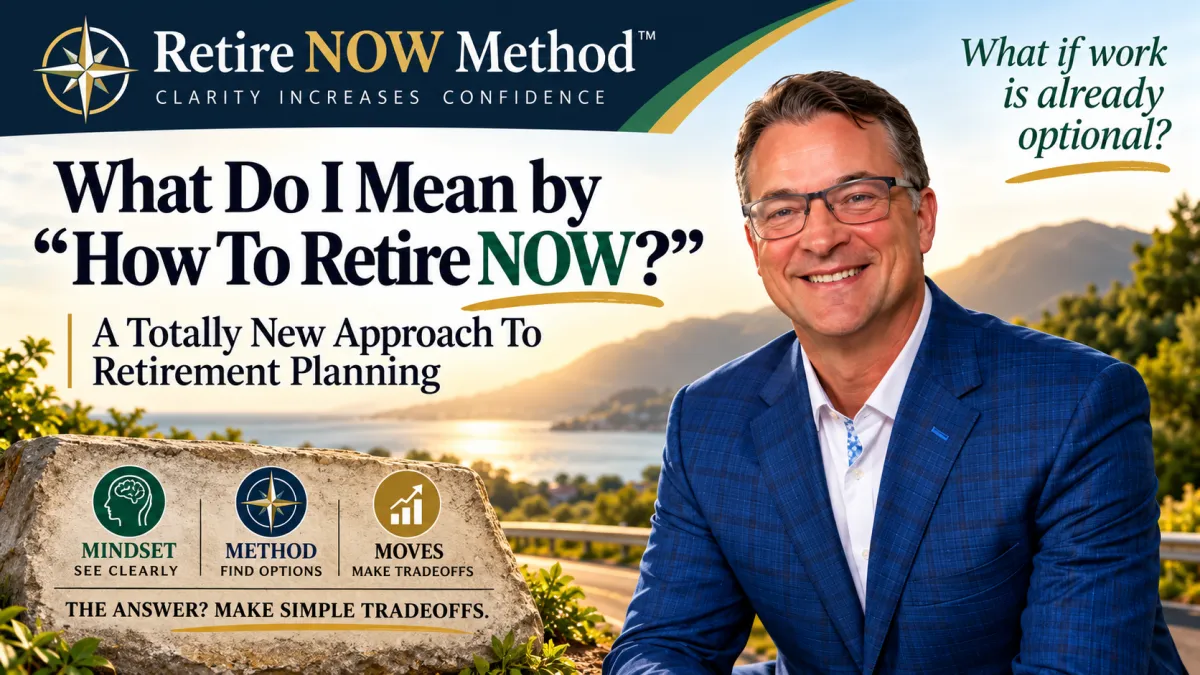
What Do I Mean by “How To Retire NOW?”
When I say How To Retire NOW, I don’t mean everyone can quit their job tomorrow.
And I certainly don’t mean everyone should.
I mean something much simpler:
What if work is already optional?
Most retirement planning starts with a very different question:
“How much money do I need to retire?”
Is it $1 million?
$1.5 million?
$2 million?
Those can be useful numbers to know. But your account balance, by itself, doesn’t tell you whether you can retire.
Because retirement isn’t really an accumulation problem.
Retirement is an income problem.
Your Account Balance Doesn’t Pay Your Bills
Imagine two people.
One has $1 million saved but needs $10,000 a month to maintain their lifestyle.
Another has $300,000 saved, a pension, Social Security, low expenses and needs only another $1,000 a month from savings.
Who is closer to retirement?
The person with $1 million has more money.
But that doesn’t necessarily mean they have a better retirement income plan.
That distinction is at the heart of How To Retire NOW.
During your working years, your financial life is relatively simple.
You work.
A paycheck arrives.
You use that paycheck to pay your bills and live your life.
Then retirement arrives and something strange happens.
The paycheck stops, but the bills don’t.
Your mortgage company doesn’t care that you retired.
The grocery store doesn’t care.
Your electric company doesn’t care.
You still need income.
The difference is that now you have to create the paycheck yourself.
Start With Income, Not Assets
So instead of beginning with:
“How much have I accumulated?”
I prefer to begin with:
“How much income do I actually need?”
Suppose you want $8,000 per month to live the retirement you want.
Now look at the reliable income already coming in.
Maybe Social Security provides $3,500.
Maybe a pension provides another $1,500.
That's $5,000 of income against an $8,000 lifestyle.
Now we know something useful.
You don't have a mysterious “retirement problem.”
You have a:
$3,000 monthly income gap.
That's a much clearer problem to solve.
And once you can see the actual problem, you can start looking at ways to solve it.
NOW Does Not Necessarily Mean Today
This is important.
The word NOW in How To Retire NOW does not mean I believe everybody should immediately quit working.
For one person, NOW might literally mean this month.
For someone else, it might mean six months from now.
For another, it might mean two years.
The point isn't the date.
The point is to stop automatically assuming the answer is later.
I've met people who continue working because they believe they have to reach some arbitrary account balance.
Or because they decided years ago that retirement happens at 65 or 67.
Or because they simply haven't asked the question:
What would actually have to be true for work to become optional?
That's the question I care about.
Because sometimes the distance between working because you have to and working because you want to is much smaller than people think.
Retirement Begins With Mindset
That's why the Retire NOW Method begins with Mindset.
Before we start moving money around, we need to see the problem clearly.
Retirement doesn't necessarily mean doing nothing.
It doesn't necessarily mean never earning another dollar.
And it certainly doesn't require winning some imaginary race to accumulate the biggest possible investment account.
To me, retirement means something much more useful:
Work becomes optional.
You may continue working.
You may start a business.
You may consult.
You may work part-time.
You may never earn another dollar.
Those are choices.
The objective is to reach the point where your financial life no longer requires you to exchange your time for a paycheck.
That's a very different mindset.
Then Comes the Method
Once we change the question, we can use a relatively simple Method.
First, determine the income you want.
Then identify the reliable income you already have.
Social Security.
Pensions.
Rental income.
Other dependable sources.
Subtract one from the other.
What's left is your income gap.
Now we have something concrete to work with.
Instead of staring at a pile of money and asking:
“Is this enough?”
we can ask:
“How do we close this gap?”
That is a much more useful question.
And that's where things get interesting.
Because You Have More Than One Move
A lot of retirement planning focuses almost entirely on the investment portfolio.
But your portfolio is only one part of your retirement.
There are many different Moves you can make.
You can make a Money Move — changing how some of your assets produce income.
You can make an Expense Move — reducing the amount of income your retirement requires.
You can make a Time Move — changing when different income sources begin.
You can make a Housing Move — changing where or how you live.
You can make an Occupational Move — replacing a full-time career with flexible, part-time or consulting income.
You can make a Distance Move — changing geography in a way that changes your cost of living or opportunities.
And sometimes the answer isn't one dramatic move at all.
It's the synergy created by several smaller moves working together.
That's why retirement can look impossible when viewed through one lens and completely different when you see all of your options.
What If You're Closer Than You Think?
This is ultimately what I mean by How To Retire NOW.
I'm not promising that everyone can retire immediately.
I'm suggesting that before you commit another three years, five years or ten years of your life to work, it might be worth finding out whether you actually need to.
Maybe the answer is:
“No, not yet.”
That's valuable clarity.
Maybe the answer is:
“Yes, but we need to make two changes first.”
That's valuable clarity too.
And occasionally the answer might be:
“You could have retired already.”
That's why I believe clarity is more valuable than simply being told what to do.
Your retirement isn't a number.
It's not an age.
And it's not a finish line somebody else gets to choose for you.
It's the point at which your resources, income and choices allow work to become optional.
So perhaps the first question isn't:
“How much money do I need to retire?”
Maybe it's:
“What would have to be true for me to retire now?”
That's where the Retire NOW Method begins.